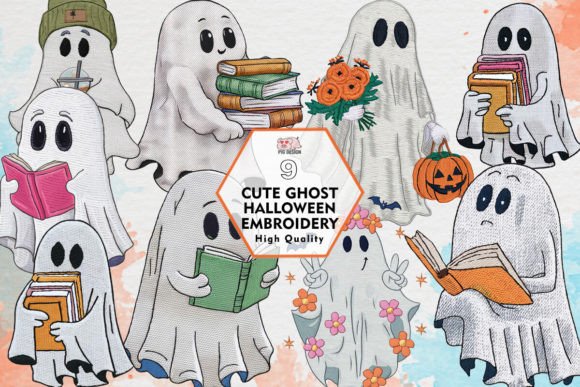
Cute Ghost Halloween Embroidery
First Impressions: Sweet, Simple, and Stitch-Ready
When I opened the Cute Ghost Halloween Embroidery PNG file, I wasn’t greeted with frantic swirls or over-rendered details—I saw a friendly, rounded ghost with soft curves, subtle shading, and just enough personality to feel handmade without demanding perfection. It’s not spooky—it’s charming. That distinction matters deeply when you’re stitching for real people: parents ordering baby onesies, boutique owners curating October-themed kitchen towels, or Etsy sellers bundling personalized holiday gifts. This isn’t a design that shouts; it smiles. And in embroidery—where clarity, stitch economy, and fabric behavior rule—that quiet confidence is gold.
Where It Shines: Real Projects, Real Fabric
Last week, I prepped a small-batch run of organic cotton tote bags for a local café’s Halloween pop-up. I chose Cute Ghost Halloween Embroidery as the centerpiece—centered on the front panel, sized to 3.2" wide. Why? Because its clean silhouette held up beautifully under satin stitch outlining and gentle fill-stitch body. No jagged edges bled into the fabric, no tiny floating details vanished mid-stitch. On medium-weight canvas, the ghost read clearly from six feet away—and up close, the 300 DPI resolution translated into smooth curves, not pixelated stair-stepping.
It performed equally well on a lightweight unisex sweatshirt (cotton-poly blend), where I used tear-away stabilizer and reduced density slightly to avoid stiffness. The ghost retained its roundness and friendliness—no distortion, no puckering. I also tested it on a tea towel hem band (linen-cotton blend) using running stitch for subtle texture. Again: legible, balanced, and unmistakably *Halloween*, but never kitschy.
Where to Pause—and Plan Ahead
This design isn’t built for micro-embroidery. If you’re stitching on a curved cap front or a toddler’s knit beanie, scale it no smaller than 2.5". Below that, the ghost’s eyes and smile risk becoming indistinct blobs—especially on textured or stretchy fabrics like fleece or jersey. Likewise, avoid dense black-on-black combos: the subtlety of its shading gets lost without contrast. For dark fabric, add a light underlay or switch to white thread with a crisp stabilizer base.
Also keep in mind: Cute Ghost Halloween Embroidery is a sublimation clipart file—not a native embroidery file. That means you’ll need to digitize it first if you’re doing machine embroidery. Don’t skip that step. A rushed auto-digitize can overload corners with unnecessary stitches or flatten its gentle gradients into muddy fills. If you’re an Etsy seller offering custom embroidered patches, test how the ghost holds up after heat pressing onto twill—some sublimation-ready graphics lose definition during transfer unless optimized for fabric adhesion.
Design Integrity Meets Customer Trust
When someone buys a hand-embroidered pillow cover with Cute Ghost Halloween Embroidery stitched on the corner, they’re not just buying decor—they’re buying intention. That ghost signals care: it’s not mass-produced clipart slapped on; it’s thoughtfully scaled, carefully stabilized, and stitched with attention to thread tension and fabric drape. Customers notice. I’ve had repeat buyers specifically ask for “that little friendly ghost” on baby blankets and aprons—proof that cohesive, well-executed design assets build recognition and trust faster than any tagline.
For craft business owners, this matters commercially too. Cute Ghost Halloween Embroidery fits seamlessly into seasonal bundles—think “Spooky & Sweet” digital embroidery collections—or as a standalone printable mockup asset for your Etsy listing. Its clean lines translate cleanly to packaging labels, thank-you cards, and social media previews. But remember: since it’s categorized under Illustrations and Graphics, confirm licensing before reselling the PNG itself or including it in editable design templates.
Practical Notes Every Embroiderer Should Check
- Test first: Run a sample on scrap fabric matching your final product—especially if using textured, stretchy, or dark materials.
- Stabilizer strategy: Medium-weight cutaway works best for knits; tear-away suffices for stable wovens like cotton duck or linen.
- Thread contrast: Try the ghost in soft gray thread on ivory fabric—it reads gently, not flat. Avoid metallics unless you want to highlight shine over shape.
- Hoop size & placement: Keep at least ½" clearance around the design. On curved surfaces (like caps), reposition the hoop mid-stitch if needed to maintain tension.
- Digital prep: If digitizing yourself, simplify interior details—this ghost doesn’t need 20 layers of fill. One smooth satin outline + two-tone fill (body + eyes) preserves charm without overloading.
- Commercial use check: Since the description says “You can print on physical products such as stickers, mugs, t-shirts, wedding cards,” verify whether resale of finished embroidered items requires attribution or limits on quantity.
Final Thought: Not Just a Ghost—A Thoughtful Design Asset
Cute Ghost Halloween Embroidery doesn’t try to do everything. It doesn’t mimic photorealism, cram in glitter effects, or shout “HALLOWEEN!” in all caps. Instead, it offers something rarer in seasonal design: restraint with warmth. It’s the kind of illustration that becomes a signature detail—stitched quietly on a child’s backpack strap, embroidered in tone-on-tone on a linen napkin, or scaled large and playful on a nursery wall hanging. For embroidery designers, small shop owners, and creative entrepreneurs, that kind of versatility isn’t accidental. It’s intentional design judgment—made before you even load the hoop.
Use it where simplicity speaks louder than spectacle. Stitch it where handmade charm matters more than flash. And always—always—test it in context, not just on screen. Because the best embroidery designs aren’t just seen. They’re felt, worn, gifted, and remembered.