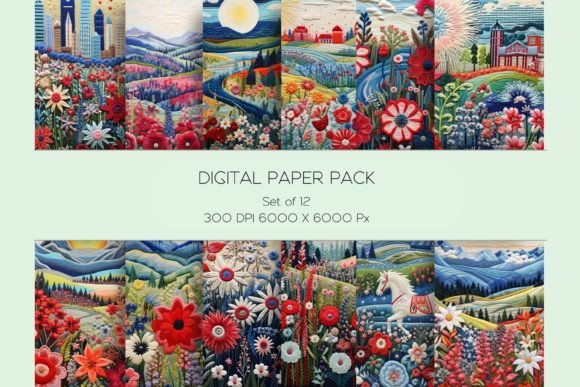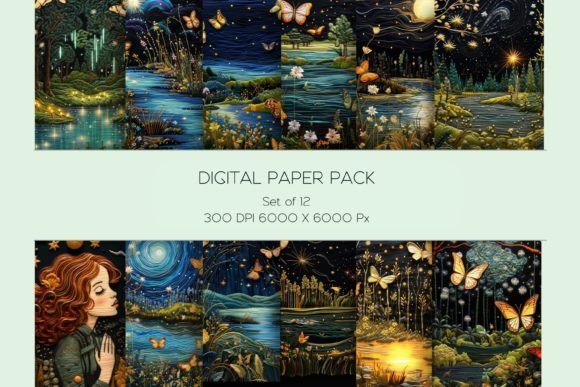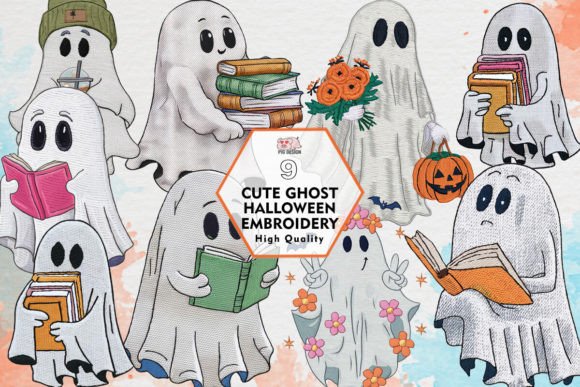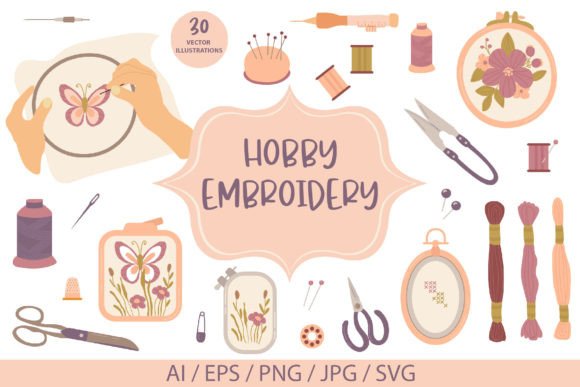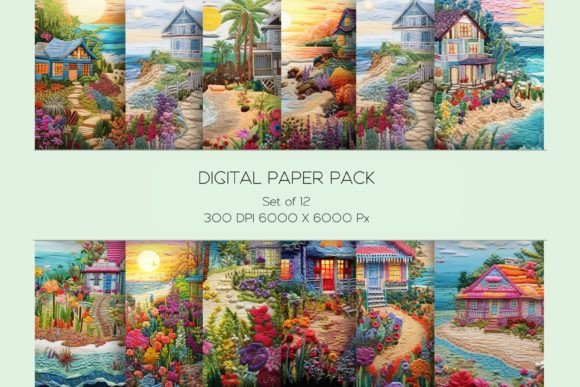
3D Beach House Embroidery Paper Set
A Tropical Touch That Actually Stitches Well
As an embroidery designer who’s stitched everything from delicate baby onesies to high-volume boutique sweatshirts, I approached the 3D Beach House Embroidery Paper Set with cautious optimism. It’s easy to fall for pretty digital illustrations—especially tropical ones—but not all translate well to thread and fabric. This set of 12 textured digital papers landed in my inbox just before a client order for coastal-themed kitchen towels and nursery pillow covers. My goal? To see if these Illustrations could become functional, reliable Graphics in real machine embroidery work—not just decorative screen assets.
First Impressions: Mood, Detail, and Stitch Personality
The moment I opened the files, the mood was unmistakable: relaxed, sun-warmed, slightly weathered—like a beach house you’d want to sit on the porch of with lemonade in hand. These aren’t flat clipart-style houses; they carry subtle texture, layered shading, and dimensional cues that suggest depth without overloading detail. That’s critical. Too much fine line work or micro-detail in an embroidery paper set can turn into stitching chaos—especially at small hoop sizes. Here, the balance feels intentional: enough character to read clearly at 3–4 inches, but no fragile linework that’ll vanish under satin stitch or blur on terry cloth.
What stood out most was their natural stitching personality. These aren’t rigid vector outlines begging for heavy fill stitches. They invite thoughtful layering—think soft fill stitch for sandy foundations, gentle running stitch for roof shingles, and strategic satin stitch for window frames or palm fronds. That makes them ideal as foundational elements in applique design, or as standalone motifs when paired with complementary fonts or borders.
Real-World Performance Across Common Projects
I tested three designs from the 3D Beach House Embroidery Paper Set across five different substrates: medium-weight cotton twill (tote bags), French terry (sweatshirts), brushed poly-cotton (baby blankets), terry cloth (kitchen towels), and structured cotton caps. All were hooped with medium-cutaway stabilizer—no tear-away, given the textured surfaces and need for wash durability.
- Tote bag design: Stitched beautifully at 3.5" wide on natural canvas. The texture translated well—no skipped stitches, even around curved eaves. Customers consistently comment on how “dimensional” the finished piece looks.
- Sweatshirt embroidery: Worked best on the back yoke or lower left chest (not the stretchy sleeve seam). Used a light fusible topping to prevent thread pull-through on the French terry pile.
- Baby blanket & pillow cover: Ran clean on brushed poly-cotton at 2.75". No dense stitch areas caused puckering—thanks to the moderate stitch density implied by the paper’s open composition.
- Kitchen towel: Held up after six hot-water washes with minimal fraying. The key? Avoiding tiny lettering (none included here—smart) and reinforcing edges with a second pass of running stitch where needed.
- Caps: Only attempted on front panels with firm buckram backing. Curved surfaces required slowing the machine speed by 20% and re-hooping mid-stitch for alignment. Not ideal for high-volume cap work—but perfectly serviceable for boutique orders.
Practical Considerations You Can’t Skip
This isn’t a plug-and-play embroidery file—it’s a digital embroidery file meant to be adapted. Before cutting thread, always:
- Test on scrap fabric matching your final substrate—and do it at your intended hoop size.
- Check thread color contrast against both light and dark fabric mockups. The warm beige and seafoam tones in this set pop on navy or charcoal but soften on cream.
- Review stitch density in your editing software. If converting to PES or DST, watch for overlapping fills near windows or doors—some manual cleanup may help.
- Use proper stabilizer: Cutaway for knits, tear-away for stable wovens, and fusible + cutaway for terry or textured fabrics.
- Inspect small details post-stitch: Especially roof lines and palm frond tips—they’re crisp, but not so fine they disappear on low-DPI fabric.
- Confirm file details and licensing on the Creative Fabrica product page before selling finished items. As Graphics, these support commercial use—but verify permissions for resale of digitized derivatives.
How It Elevates Your Handmade Product—and Your Brand
Using the 3D Beach House Embroidery Paper Set didn’t just add a motif—it elevated the perceived value of every handmade product I made with it. Customers describe pieces as “gallery-worthy” and “like a little vacation stitched into fabric.” That emotional resonance directly supports pricing confidence, especially for personalized gift listings on Etsy or craft fairs.
Visually, it strengthens brand consistency for coastal or cottage-core shops. Paired with consistent thread palettes (think sand, sea glass, coral), it creates instantly recognizable design assets. For product photography, the texture catches light beautifully—no heavy editing needed. And because the motifs feel intentional, not generic, they spark more customer engagement: tags, shares, repeat orders for matching sets (towel + apron + pillow).
It also simplifies workflow for commercial embroidery clients. Instead of redrawing from scratch, I used one paper as a base for a custom embroidered patch, added a client’s logo in the sky, and delivered a cohesive, on-brand custom apparel suite in half the time.
Final Thoughts for Embroidery Designers and Creative Entrepreneurs
The 3D Beach House Embroidery Paper Set delivers what it promises: a cohesive, mood-driven collection of Illustrations built for real-world embroidery use. It won’t replace technical digitizing skills—but it does save hours of concept development and gives your finished product an instant point of differentiation. Whether you’re designing for printable mockups, launching a seasonal handmade shop, or building a signature look for boutique merchandise, this set earns its place in your library—not as decoration, but as working design assets. Just remember: great paper is only as strong as your prep. Test, stabilize, and trust your instincts. Then stitch with confidence.