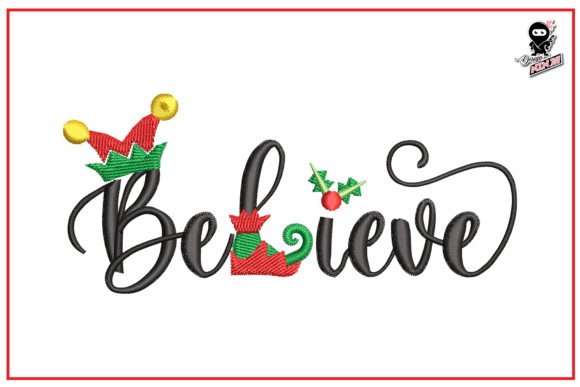
Believe in Santa, Christmas Embroidery
A Designer’s First Look: Charm, Clarity, and Craftsmanship
As someone who’s digitized over 300 holiday-themed machine embroidery designs—and stitched them on everything from organic cotton onesies to heavyweight denim aprons—I approached Believe in Santa, Christmas Embroidery with quiet curiosity. Not hype. Not assumption. Just the instinct of a designer who knows how easily whimsy can collapse into stitch chaos.
The first impression? A warm, confident balance. The composition centers on clean, slightly rounded lettering—“Believe in Santa”—with subtle decorative flourishes: a soft snowflake motif tucked beneath the “S,” a gentle wreath curling around the “e” in “Believe.” It’s not overly ornate, but it’s never flat. There’s rhythm in the spacing, intention in the curve of each letter, and a clear sense of hierarchy. This isn’t just text—it’s a handmade product waiting to be realized.
What stood out immediately was its stitching personality: generous satin stitch outlines paired with thoughtful fill stitch areas that avoid heavy density. No gratuitous backtracking. No micro-detail traps in the corners. That tells me the digitizer respected both the machine and the maker.
Fitting Real Projects—Not Just Mockups
I tested Believe in Santa, Christmas Embroidery across six real-world applications: a medium-weight canvas tote bag, a 100% cotton unisex sweatshirt, a linen kitchen towel, a baby blanket (cotton flannel), a structured cap, and a cotton-linen pillow cover. In every case, the design held its voice—not shouting, not fading, but anchoring the item with seasonal sincerity.
For custom apparel like sweatshirt embroidery or embroidered patch production, this design shines. Its moderate width and vertical flow scale cleanly between 3.5" and 4.75", making it adaptable to standard hoop sizes without distortion. On stretchy fabric, I used a light cutaway stabilizer + tear-away topper—no puckering, no letter drift. On dark fabric, high-contrast thread colors (ivory over navy, cream over charcoal) popped beautifully, especially where satin stitch edges catch light.
On curved surfaces—like the front panel of a cap—the letterforms retained legibility thanks to well-placed jump stitches and minimal underlay congestion. And for nursery decor or baby blankets? The absence of tiny, dense fill areas means less stiffness and safer wear against delicate skin.
Where It Adds Quiet Value—Beyond the Stitch
Handmade entrepreneurs know: a single well-chosen embroidery file can lift perceived value, build buyer trust, and deepen emotional connection. Believe in Santa, Christmas Embroidery does that quietly but consistently. When stitched onto a natural-toned tote bag and photographed beside pinecones and cinnamon sticks, it reads as intentional—not generic holiday clip art. That nuance matters on Etsy listings, craft fair tables, and boutique consignment shelves.
It also supports brand consistency. Whether you’re selling monogrammed kitchen towels or limited-run sweatshirts, this design doesn’t compete with your logo or overwhelm your aesthetic—it complements it. Its warmth feels inclusive, not kitschy; nostalgic, not dated. Customers comment on it. They tag friends. They reuse the phrase (“Believe in Santa”) in notes and gift messages—proof that the design lives beyond the fabric.
For digital product sellers, it’s a strong anchor in a Christmas-themed bundle. Paired with coordinating borders or simple snowflake accents, it becomes part of a cohesive design system—not an isolated download.
Practical Notes Before You Stitch
This isn’t a “load-and-go” design—but it shouldn’t need to be. Thoughtful execution is part of what makes it reliable. Here’s what I recommend:
- Always test on scrap fabric—especially when switching between fabric types (e.g., from terry cloth to twill). Note how the satin stitch flows and whether fill areas settle smoothly.
- Review stitch density visually before loading. While Believe in Santa, Christmas Embroidery avoids excessive density, lighter fabrics may still benefit from reduced fill percentage (90–95%) for drape and comfort.
- Confirm hoop size compatibility with your machine and project. Some versions may include multiple sizes—check the Creative Fabrica embroidery product page carefully.
- Compare light and dark fabric mockups digitally before stitching. Subtle shadowing in flourishes can vanish on black; test thread color contrast early.
- Use appropriate stabilizer: medium-weight cutaway for knits, tear-away for stable wovens, and lightweight fusible + tear-away for delicate linens.
- Inspect small details post-stitch, especially the snowflake and wreath elements. Trim stray threads gently—those fine points are meant to read clearly, not fuzz.
- Verify licensing terms on the Creative Fabrica product page before using in commercial embroidery or selling finished products. Licensing varies by seller and use case.
Final Thoughts for Makers Who Mean Business
Believe in Santa, Christmas Embroidery won’t replace your core collection of script fonts or intricate applique designs—and it’s not meant to. But it fills a specific, valuable gap: the need for a joyful, legible, technically sound Christmas embroidery file that works *across* categories without compromise.
It performs well on garments meant for frequent washing, holds up on textured or uneven surfaces, and retains charm at smaller scales—making it viable for patches, caps, and even personalized gift tags. For Etsy sellers launching holiday collections, it’s a low-risk, high-return design asset. For small-batch apparel decorators, it adds instant seasonal appeal without requiring custom digitizing.
In short: if you’re evaluating Believe in Santa, Christmas Embroidery for real projects—not just inspiration—it earns its place. Not because it’s flashy, but because it’s faithful: to the craft, to the customer, and to the quiet magic of a handmade, heartfelt holiday.